
C ++ Programming Examples
Example:
Maximal number of rows and columns matrix can have is predefined. Write your own main program which reads given number of matrix’s rows and columns, and additionally reads matrix’s given elements. Main program prints:
- Matrix’s elements sum (calls upon a function that calculates elements sum)
- Maximal value in every row of a matrix (calls upon a function that finds the biggest element in a flow)
Matrix mat is declared in a way of two dimensional array (2D array):
float mat[MAXROW][MAXCOL];Variables nrRow and nrCol store matrix’s dimensions provided by user. The image below shows you this in a visual way. Click on the image to enlarge it.

Memory of a computer allocates MAXROW * MAXCOL * sizeof(float) byte.Matrix’s rows follow one after another, in a way where every next row is placed right after the previous one; and so on. Picture below describes this perfectly. Click on the image to enlarge it.
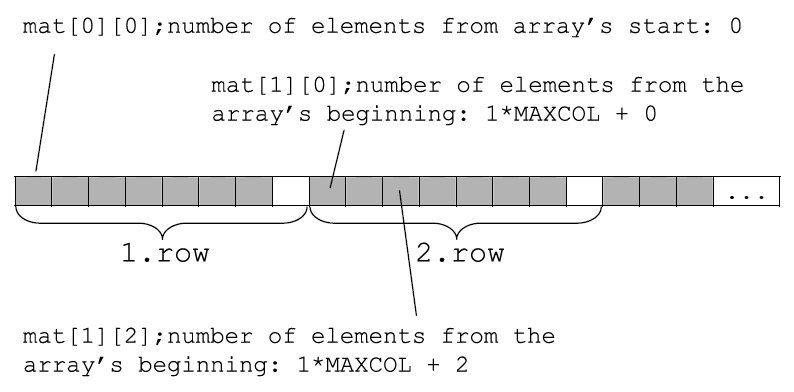
Generally speaking, for mat[i][j] – number of elements from the beginning of an array is: i * MAXCOL + j
#include <stdio.h>
#define MAXROW     100
#define MAXCOL     100


float max( int len, float *p ) {
// OR: float max( int len, float p[] )

   float res;
   int i;

printf("\nIn function max :");
   printf("\nRow’s beginning address
         in memory : %ld", p);
   res = p[0];
   for( i=1; i<len; i++ )
      if( p[i] > res )
         res = p[i];
   return res;
}


float sumEl(int nrRow,int nrCol,
        int maxCol,float *mat) {

int i, j;
   float sum;

   printf("\nIn function sumEl:");
   printf("\nMatrix’s beginning address
         in memory: %ld", mat);
printf("\nBegin. of 2nd row’s addr.
         in mem.: %ld", &mat[maxCol]);
   printf("\nBegin. of 3rd row’s addr.
         in mem.: %ld", &mat[2* maxCol]);

   sum = 0.0;
   for( i=0; i<nrRow; i++ )
      for( j=0; j<nrCol; j++ )
         sum += mat[i*maxCol + j];
  // or: sum += *(mat + i*maxCol + j)

   return sum;
}


int main(void) {
   int row, col, i, j;
   float add, maxRow, mat[MAXROW][MAXCOL];

   printf("\nInput nr. of rows and columns:");
   scanf("%d %d", &row, &col );

   printf("\nIn function main");
   printf("\nMatrix’s beginning address
         in memory: %ld", mat);
   printf("\nBegin. of 2nd row’s
         addr.: %ld\n\n", &mat[1][0]);
   printf("\nBegin. of 3rd row’s
         addr.: %ld\n\n", &mat[2][0]);
   for( i=0; i<row; i++ )
      for( j=0; j<col; j++ ) {
         printf("Input element[%d,%d]:",i,j);
         scanf("%f", &mat[i][j] );
   }


   //calculates elements sum in matrix

   add=sumEl(row,col,MAXCOL,(float *) mat);
   printf("\n\nSum of matrix
           elements is %f", add );


   //prints maximal value of every mat. row

   for(i=0;i<row;i++) {
      maxRow = max(col, &mat[i][0]);
        // or: max(col, mat+i*MAXCOL)
      printf("\nBiggest element in
            row %d is %f\n",i,maxRow);
   }
}
Example of program’s execution:
Input nr. of rows and columns:  3  2

In function main :
Matrix’s beginning address in memory :  1205032
Begin. of 2nd row’s addr.  :                      1205432
Begin. of 3rd  row’s addr.  :                      1205832


3rd:

 1205432     =  125032 + 1 * MAXCOL * sizeof(float)                    =  125032 + 400;
 1205832     =  125032 + 2 * MAXCOL * sizeof(float)
                    =  125032 + 800;


Input element [0,0]:  2
Input element [0,1]:  3
Input element [1,0]:  4
Input element [1,1]:  3
Input element [2,0]:  1
Input element [2,1]:  5


In function sumEl:
Matrix’s beginning address in memory:  1205032
Begin. of 2nd row’s addr. in mem.:         1205432
Begin. of 3rd  row’s addr. in mem.:         1205832


Sum of matrix elements is 18.000000
In function max:
Row’s beginning address in memory:  1205032
Biggest element in row 0 is 3.000000


In function max:
Row’s beginning address in memory:  1205432
Biggest element in row 1 is 4.000000


In function max:
Row’s beginning address in memory:  1205832
Biggest element in row 2 is 5.000000
Example:
Write your own C function which returns flow of matrix row’s maximal values.
void maxFlow(float *mat,int nrRow,int nrCol,
         int maxCol,float *flow) {

//OR: void maxFlow(float mat[], int nrRow,
     int nrCol,int maxCol,float flow[])

   int i, j;
   for (i = 0; i < nrRow; i++) {
      flow[i] = mat[i * maxCol];
      for(j = 1; j < nrCol; j++)
         if (mat[i*maxCol+j] > flow[i])
            flow[i]=mat[i*maxCol+j];
   }
}

No comments:
Post a Comment